

Definite integrals and their rules, using anti-derivatives and the constant of integration, evaluating areas under a curve, between a curve and the x-axis, and between two curves, with ∫abf(x)dx=[F(x)]ab,
Integrals are a powerful tool that allow us to calculate the area under a curve.
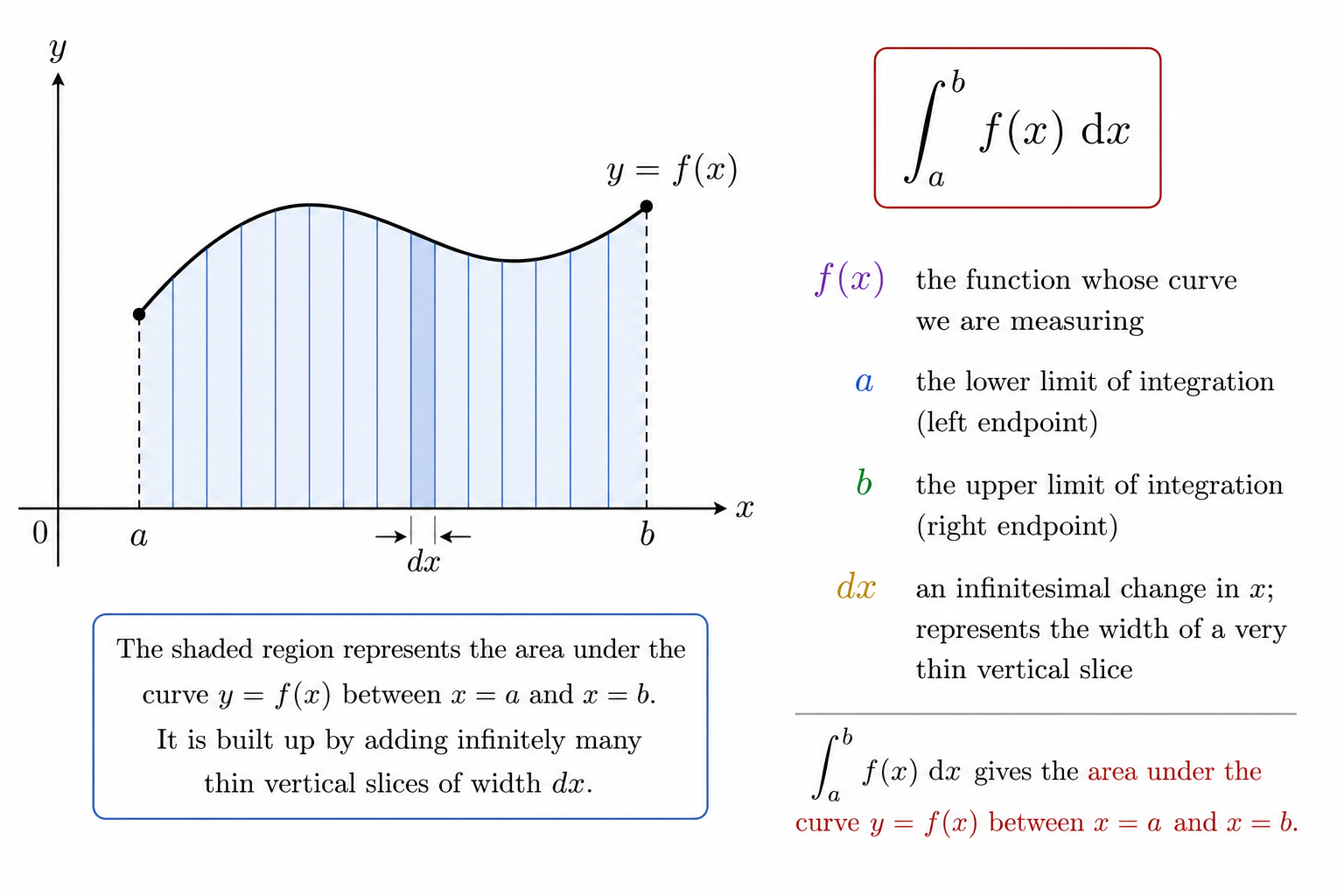
The essence of integration is to draw rectangles under the curve, each with a height matching the function at each point. Adding up the area of these rectangles gives an approximation for the area under the curve. Increasing the number of rectangles makes the approximation more precise.
The real "trick" of integration is imagining what happens when the number of rectangles approaches infinity. In this case, the width each each rectangle approaches zero, and their combined area approaches that of the true region under the curve.
This infinite sum of rectangles is what we call a definite integral, and uses the notation
The word definite here refers to the bounds a and b. Later in this lesson we'll explain what an integral without bounds might mean.
The area of an infinite number of rectangles might seem a strange concept. But in reality, by following careful mathematical steps we can actually find the exact area under most curves. This process is called Riemann Integration, and the IB does not expect you to know how to perform it exactly. Instead, we will learn a series of rules for calculating
The area between a curve f(x)>0 and the x-axis is given by
The trapezoid rule is a technique for more accurately approximating the area beneath a curve from x=a to x=b. Instead of summing rectangles, it works by summing the area of n trapezoids of equivalent width.
Each trapezoid's area is the common width (nb−a) times the average of the function's value on the left and right side of the trapezoid:
The formula for the area using the trapezoid rule approximation is
where h=nb−a.
Recognize that b=3, a=0 and n=6, so the width of each trapezoid is
Using the formula, the area is
Each yk=e0.5×k, but thankfully we can use our calculator here:
In L1 enter 0,1…6.
At the top of L2, set L2=e0.5L1 and hit enter. The values fill in:
Now (y0+y6+2(y1+⋯+y5)) is
So the area is
Integration, or anti-differentiation, is essentially the opposite of differentiation. We use the integral symbol∫ and write:
By convention we denote this function F:
We can also write
Notice the dx under the integral. This tells us which variable we are integrating with respect to - in this case we are reversing dxd.
Since the derivative of a constant is always zero, then if if F′(x)=f(x), then (F(x)+C)′=f(x).
This means that when we integrate, we can add any constant to our result, since differentiating makes this constant irrelevant:
In the same way that constant multiples can pass through the derivative, they can pass through the integral:
And in the same way that the derivative of a sum is the sum of the derivatives:
If we know the value of y or f(x) for a given x, we can determine C by plugging in x and y.
A definite integral is evaluated between a lower and upper bound.
We can solve a definite integral with
where F(x)=∫f(x)dx.
Graphing calculators can be used to evaluate definite integrals.
For example, on a TI-84, math > 9:fnInt(, which prompts you with ∫□□(□)d□. Make sure the variable of your function matches the variable that you take the integral with respect to.
Integrals of the same function with adjacent domains can be merged:
Similarly, the domain of an integral can be split:
for any a<m<b.
Nice work completing Definite Integrals, Areas, and Basic Anti-Derivatives, here's a quick recap of what we covered:
Exercises checked off
Definite integrals and their rules, using anti-derivatives and the constant of integration, evaluating areas under a curve, between a curve and the x-axis, and between two curves, with ∫abf(x)dx=[F(x)]ab,
Integrals are a powerful tool that allow us to calculate the area under a curve.
The essence of integration is to draw rectangles under the curve, each with a height matching the function at each point. Adding up the area of these rectangles gives an approximation for the area under the curve. Increasing the number of rectangles makes the approximation more precise.
The real "trick" of integration is imagining what happens when the number of rectangles approaches infinity. In this case, the width each each rectangle approaches zero, and their combined area approaches that of the true region under the curve.
This infinite sum of rectangles is what we call a definite integral, and uses the notation
The word definite here refers to the bounds a and b. Later in this lesson we'll explain what an integral without bounds might mean.
The area of an infinite number of rectangles might seem a strange concept. But in reality, by following careful mathematical steps we can actually find the exact area under most curves. This process is called Riemann Integration, and the IB does not expect you to know how to perform it exactly. Instead, we will learn a series of rules for calculating
The area between a curve f(x)>0 and the x-axis is given by
The trapezoid rule is a technique for more accurately approximating the area beneath a curve from x=a to x=b. Instead of summing rectangles, it works by summing the area of n trapezoids of equivalent width.
Each trapezoid's area is the common width (nb−a) times the average of the function's value on the left and right side of the trapezoid:
The formula for the area using the trapezoid rule approximation is
where h=nb−a.
Recognize that b=3, a=0 and n=6, so the width of each trapezoid is
Using the formula, the area is
Each yk=e0.5×k, but thankfully we can use our calculator here:
In L1 enter 0,1…6.
At the top of L2, set L2=e0.5L1 and hit enter. The values fill in:
Now (y0+y6+2(y1+⋯+y5)) is
So the area is
Integration, or anti-differentiation, is essentially the opposite of differentiation. We use the integral symbol∫ and write:
By convention we denote this function F:
We can also write
Notice the dx under the integral. This tells us which variable we are integrating with respect to - in this case we are reversing dxd.
Since the derivative of a constant is always zero, then if if F′(x)=f(x), then (F(x)+C)′=f(x).
This means that when we integrate, we can add any constant to our result, since differentiating makes this constant irrelevant:
In the same way that constant multiples can pass through the derivative, they can pass through the integral:
And in the same way that the derivative of a sum is the sum of the derivatives:
If we know the value of y or f(x) for a given x, we can determine C by plugging in x and y.
A definite integral is evaluated between a lower and upper bound.
We can solve a definite integral with
where F(x)=∫f(x)dx.
Graphing calculators can be used to evaluate definite integrals.
For example, on a TI-84, math > 9:fnInt(, which prompts you with ∫□□(□)d□. Make sure the variable of your function matches the variable that you take the integral with respect to.
Integrals of the same function with adjacent domains can be merged:
Similarly, the domain of an integral can be split:
for any a<m<b.
Nice work completing Definite Integrals, Areas, and Basic Anti-Derivatives, here's a quick recap of what we covered:
Exercises checked off