Perplex
  • Dashboard
Topics
Exponents & LogarithmsRounding & ErrorSequences & SeriesFinancial MathematicsMatricesComplex Numbers
Paper 3
Plus
Calculator Skills
Review VideosFormula BookletAll Study Sets
Sign UpLogin
Perplex
Perplex
  • Dashboard
Topics
Exponents & LogarithmsRounding & ErrorSequences & SeriesFinancial MathematicsMatricesComplex Numbers
Paper 3
Plus
Calculator Skills
Review VideosFormula BookletAll Study Sets
Sign UpLogin
Perplex
/
Rounding & Error
/
Error
Mixed Practice
Error
Rounding & Error

Error

0 of 0 exercises completed

Approximation, absolute and percentage error using ​∣VA​−VE​∣​ and ​VE​∣VA​−VE​∣​×100%, together with error bounds from rounding or measurement and how they propagate through calculations.

Approximation error bounds
SL AI 1.6

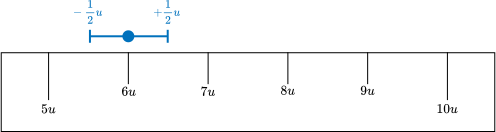
A measurement is always accurate to ​±21​​ ("plus or minus one half") of the smallest division on the scale. The same idea applies to rounding numbers: the rounded value is accurate to ​±21​​ the value of the digit "place" (tens, ones, tenths, hundredths, etc.) it is rounded to.
problem image

Typically, we express the error bounds of a number ​x​ using inequalities:

​
x−21​u≤x<x+21​u
​

where ​x​ is the measured value, ​u​ is the smallest unit on the scale we used. Note that some people equivalently write

​
x∈[x−21​u,x+21​u)
​

The upper bound, ​x+21​u, is not included since it would be rounded up to the next increment.

Absolute and percentage error
SL AI 1.6

The actual size of an error is the difference between the approximated value (​VA​​) and the exact value (​VE​​). We call this the absolute error, and can calculate it with the equation

​
absolute error =∣VA​−VE​∣
​

Expressing the error as a percentage of the exact value allows us to see how much the error "matters" in a specific scenario. This is the percentage error, which we calculate with the equation

​
percentage error =VE​∣VA​−VE​∣​×100%
​
Bounds of calculation based on other approximations
SL AI 1.6

The error bounds of values like length and width impact the error bounds of any secondary calculation, like area, that we use them to find. For example, if an object of length ​l​ and width ​w​ has error bounds ​0.9≤l≤1.1​ and ​2.6≤w≤2.9, then the object's minimum and maximum area are

​
Amin​=0.9(2.6)=2.34
​
​
Amax​=1.1(2.9)=3.19
​

i.e., the error bounds are ​2.34≤A<3.19.

Nice work completing Error, here's a quick recap of what we covered:

Skills covered

Mixed Practice

Exercises checked off

I'm Plex, here to help you understand this concept!
/
Rounding & Error
/
Error
Mixed Practice
Error
Rounding & Error

Error

0 of 0 exercises completed

Approximation, absolute and percentage error using ​∣VA​−VE​∣​ and ​VE​∣VA​−VE​∣​×100%, together with error bounds from rounding or measurement and how they propagate through calculations.

Approximation error bounds
SL AI 1.6

A measurement is always accurate to ​±21​​ ("plus or minus one half") of the smallest division on the scale. The same idea applies to rounding numbers: the rounded value is accurate to ​±21​​ the value of the digit "place" (tens, ones, tenths, hundredths, etc.) it is rounded to.

problem image

Typically, we express the error bounds of a number ​x​ using inequalities:

​
x−21​u≤x<x+21​u
​

where ​x​ is the measured value, ​u​ is the smallest unit on the scale we used. Note that some people equivalently write

​
x∈[x−21​u,x+21​u)
​

The upper bound, ​x+21​u, is not included since it would be rounded up to the next increment.

Absolute and percentage error
SL AI 1.6

The actual size of an error is the difference between the approximated value (​VA​​) and the exact value (​VE​​). We call this the absolute error, and can calculate it with the equation

​
absolute error =∣VA​−VE​∣
​

Expressing the error as a percentage of the exact value allows us to see how much the error "matters" in a specific scenario. This is the percentage error, which we calculate with the equation

​
percentage error =VE​∣VA​−VE​∣​×100%
​
Bounds of calculation based on other approximations
SL AI 1.6

The error bounds of values like length and width impact the error bounds of any secondary calculation, like area, that we use them to find. For example, if an object of length ​l​ and width ​w​ has error bounds ​0.9≤l≤1.1​ and ​2.6≤w≤2.9, then the object's minimum and maximum area are

​
Amin​=0.9(2.6)=2.34
​
​
Amax​=1.1(2.9)=3.19
​

i.e., the error bounds are ​2.34≤A<3.19.

Nice work completing Error, here's a quick recap of what we covered:

Skills covered

Mixed Practice

Exercises checked off

I'm Plex, here to help you understand this concept!

Generating starter questions...

1 free

Generating starter questions...

1 free