Perplex
  • Dashboard
Topics
Cartesian plane & linesFunction TheoryModellingTransformations & asymptotes
Paper 3
Plus
Calculator Skills
Review VideosFormula BookletAll Study Sets
Sign UpLogin
Perplex
Perplex
  • Dashboard
Topics
Cartesian plane & linesFunction TheoryModellingTransformations & asymptotes
Paper 3
Plus
Calculator Skills
Review VideosFormula BookletAll Study Sets
Sign UpLogin
Perplex
/
Modelling
/
Exponential Models
Log models, scales and linearization
Exponential Models
Modelling

Exponential Models

0 of 0 exercises completed
Modeling growth and decay with functions of the form ​Abx+c​ or ​Aebx+c, as well as the concept of half-life for exponential decay.
Exponential models
SL AI 2.5

An exponential model represents quantities that multiply repetetively by a constant factor ​b. The basic form of an exponential is ​bx, but any exponential can be written in the form ​Abx+k.


The graph of an exponential model is a curve that approaches a horizontal asymptote at ​y=k​ on one side, and has a ​y​-intercept at ​(0,A+k). Because of the asymptote on an exponential graph, exponential models are good at describing behaviors that level off over time.

Exponential growth
SL AI 2.5

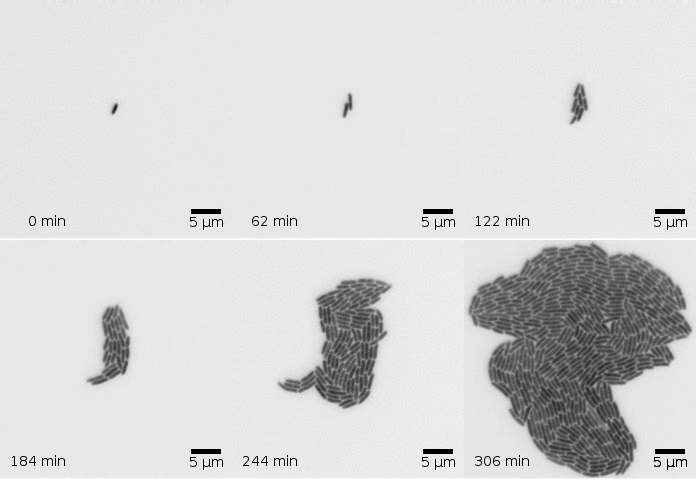
Exponential growth describes quantities that increase by the same factor over a certain amount of time. Algebraically, exponential growth is modeled by functions of the form

​
f(t)=Abt+c,
​

where ​b>1.  ​b​ is called the growth factor.


Note: ​Aekt​ is another model for exponential growth if the instantaneous growth rate, ​k, is positive.

problem image

Stewart EJ, Madden R, Paul G, Taddei F (2005), CC BY-SA 4.0

Exponential decay
SL AI 2.5

Exponential decay describes quantities that decrease by the same factor over a certain amount of time. Exponential decay is modeled by functions of the form

​
f(t)=Abt+c,
​

where ​0<b<1.  ​b​ is called the decay factor.


Note: ​Aekt​ is another model for exponential decay if the instantaneous growth rate, ​k, is negative.

Concept of half-life
AHL AI 2.9

For any quantity that decays exponentially, the half-life is the amount of time it takes for the quantity to halve in value.

Calculating half-life
AHL AI 2.9

From any exponential decay model of the form ​f(t)=Abkt​ (​0<b<1​), the half-life, or time for the value of ​f​ to reach half of its current value, is given by ​t1/2​=−klogb​2​.


Most commonly, given an equation of the form ​f(t)=Aekt, the half life is given by ​−kln2​.

Nice work completing Exponential Models, here's a quick recap of what we covered:

Skills covered

Mixed Practice

Exercises checked off

I'm Plex, here to help you understand this concept!
/
Modelling
/
Exponential Models
Log models, scales and linearization
Exponential Models
Modelling

Exponential Models

0 of 0 exercises completed
Modeling growth and decay with functions of the form ​Abx+c​ or ​Aebx+c, as well as the concept of half-life for exponential decay.
Exponential models
SL AI 2.5

An exponential model represents quantities that multiply repetetively by a constant factor ​b. The basic form of an exponential is ​bx, but any exponential can be written in the form ​Abx+k.


The graph of an exponential model is a curve that approaches a horizontal asymptote at ​y=k​ on one side, and has a ​y​-intercept at ​(0,A+k). Because of the asymptote on an exponential graph, exponential models are good at describing behaviors that level off over time.

Exponential growth
SL AI 2.5

Exponential growth describes quantities that increase by the same factor over a certain amount of time. Algebraically, exponential growth is modeled by functions of the form

​
f(t)=Abt+c,
​

where ​b>1.  ​b​ is called the growth factor.


Note: ​Aekt​ is another model for exponential growth if the instantaneous growth rate, ​k, is positive.

problem image

Stewart EJ, Madden R, Paul G, Taddei F (2005), CC BY-SA 4.0

Exponential decay
SL AI 2.5

Exponential decay describes quantities that decrease by the same factor over a certain amount of time. Exponential decay is modeled by functions of the form

​
f(t)=Abt+c,
​

where ​0<b<1.  ​b​ is called the decay factor.


Note: ​Aekt​ is another model for exponential decay if the instantaneous growth rate, ​k, is negative.

Concept of half-life
AHL AI 2.9

For any quantity that decays exponentially, the half-life is the amount of time it takes for the quantity to halve in value.

Calculating half-life
AHL AI 2.9

From any exponential decay model of the form ​f(t)=Abkt​ (​0<b<1​), the half-life, or time for the value of ​f​ to reach half of its current value, is given by ​t1/2​=−klogb​2​.


Most commonly, given an equation of the form ​f(t)=Aekt, the half life is given by ​−kln2​.

Nice work completing Exponential Models, here's a quick recap of what we covered:

Skills covered

Mixed Practice

Exercises checked off

I'm Plex, here to help you understand this concept!

Generating starter questions...

1 free

Generating starter questions...

1 free